
The Animal Wellbeing Zookeeper Subcommittee grows and supports animal wellbeing culture throughout each region. Each month, a member of Animal Care will provide an interesting update from their region.
May 2026 - "Sharing is Caring! Expanding Enrichment Opportunities Across Regions"
By Stephen Fry, North America Trek & Polar Frontier
If you’ve ever walked around the Zoo (as I hope most of us have), you will see a wide variety of ever-changing toys and furniture in animal habitats for their enjoyment. Often, you’ll see the same items, albeit different sizes/colors, being offered to vastly different species. As Animal Care staff, we are always asking other departments what works well, what doesn’t, and at times, if we can borrow some items until we are able to purchase some for our own department. This has become a favorite way to expand what can be offered to the critters that call North America Trek, Adventure Cove, and the Watering Hole home.
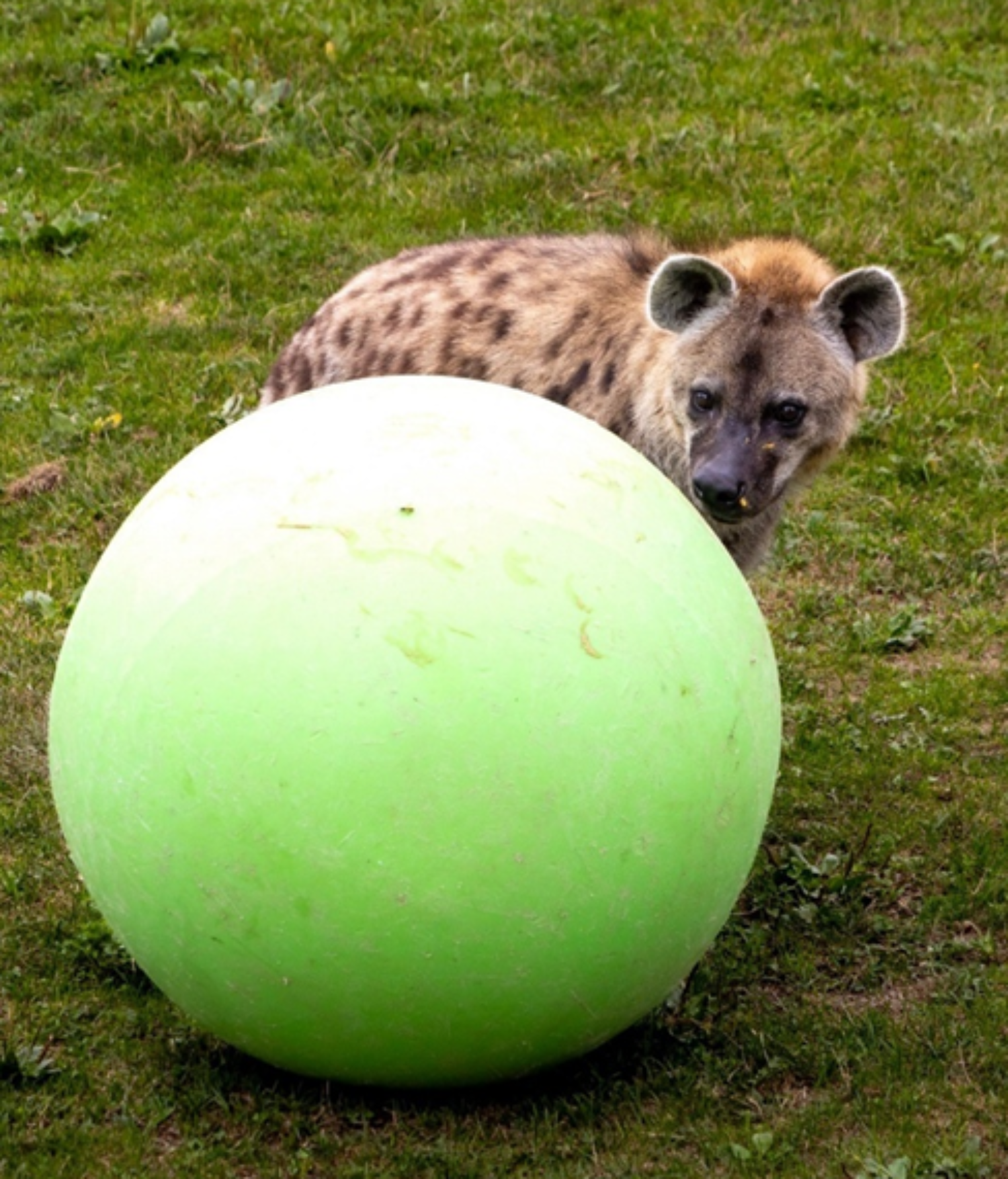
This all started several years ago, when Wild Encounters Africa was looking for durable enrichment to offer the hyenas. Where else would you look than Polar Frontier, which houses some of the most destructive animals in Columbus: Brutus and Buckeye? The logic was simple; if the toys were strong enough to stand up to the bears, surely they would work for the hyenas. Since then, every few weeks, the WE Africa team will stop by and pick out a toy that they can offer as novel enrichment, returning the previous toy at the same time. Not only is the physical toy novel, but coupled with the scent of the bears, the watering hole critters are getting a 2-for-1 special!
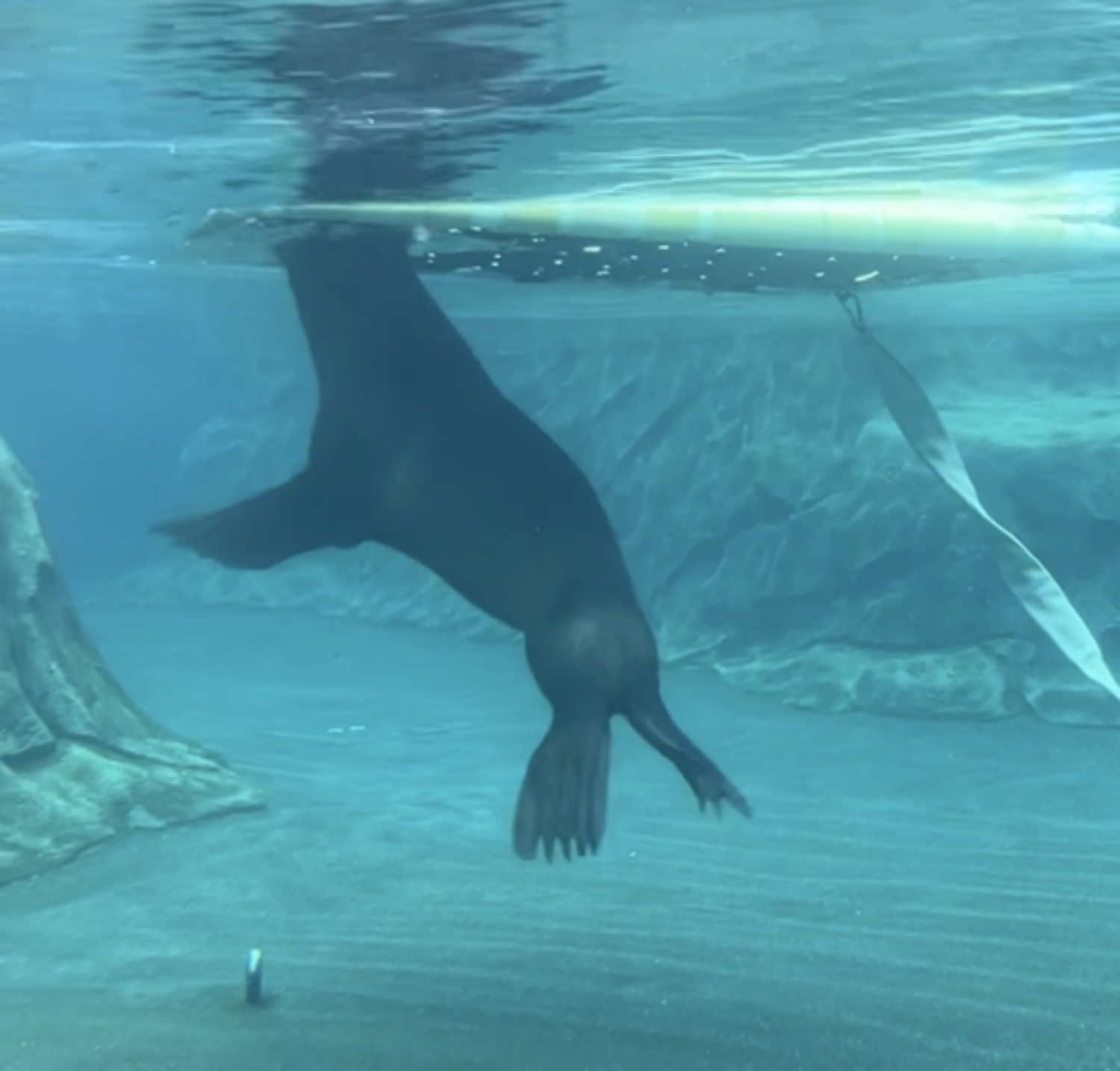
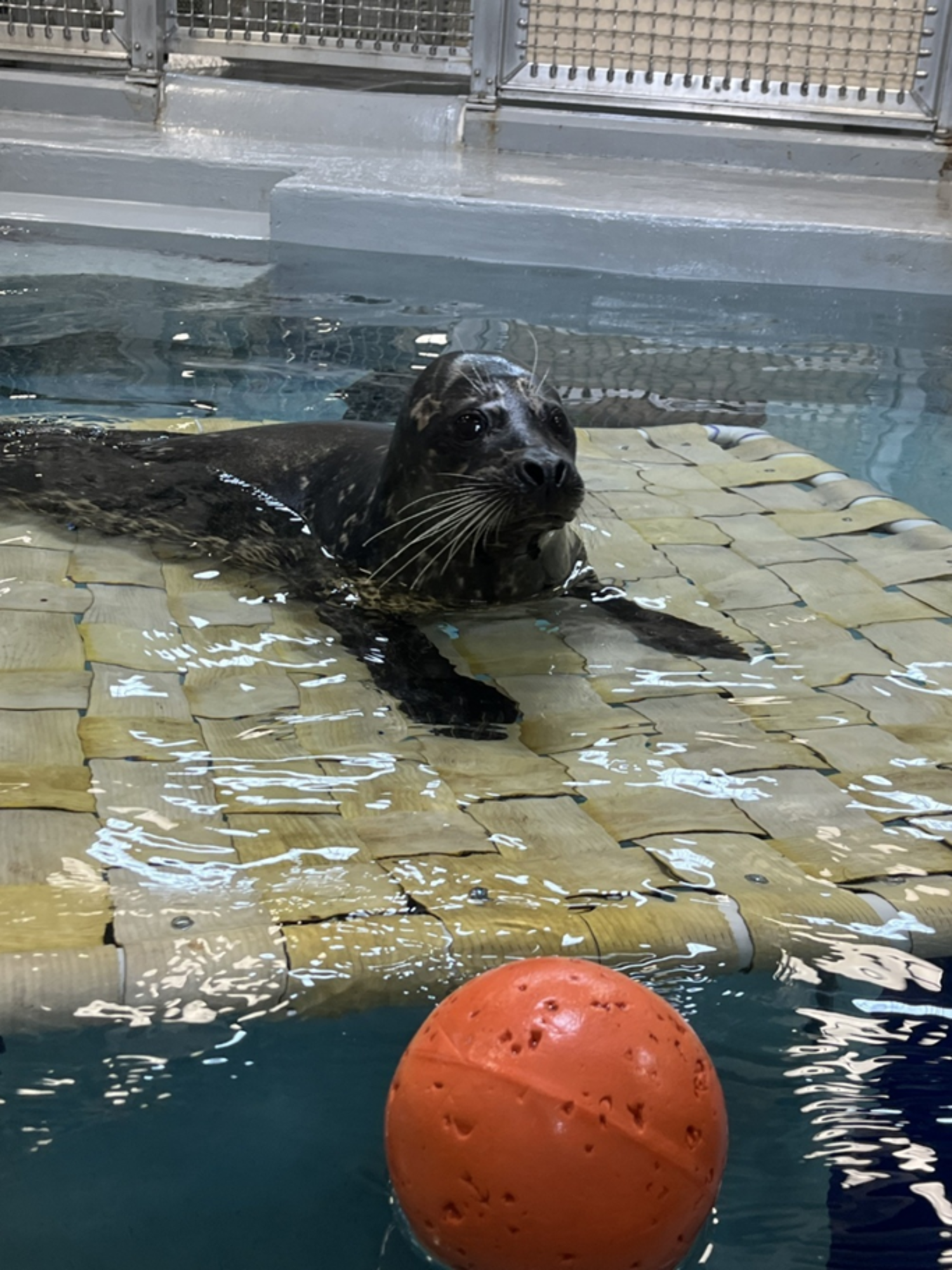
Shortly after this was established, the Wild Encounters Pinniped team reached out as well, because a lot of what the polar Bears and river otters find most fun, seals and sea lions enjoy as well. The double benefit here is for our polar bears, with toys often returning with the scent of pinnipeds, which is, of course, similar to the natural prey species of their wild arctic counterparts. And while river otters are significantly smaller, we have swapped floating discs and rafts that the sea lions have found interesting ways to utilize. Recently, the pinnipeds team borrowed a floating raft that was built for the otter boys, except Sunshine decided that it worked better as a hat! The harbor seals understood the assignment just a little bit better.
When all is said and done, these partnerships have been a roaring
success – both in terms of animal wellbeing and reduced spending. As Animal Care staff, we are willing to do whatever we can to ensure the animals in our care receive the best wellbeing possible, and little things like sharing enrichment have been a big success for so many species here at the zoo!
April 2026 - "A Healthier Step Forward: Kipawa's Hoof Story"
By HOA Animal Care Staff
One of the largest wellbeing goals in Heart of Africa is achieving and maintaining proper hoof care for our animals. As a department that is heavily made up of hoofstock, this means continuously monitoring and maintaining a significant number of hooves. In the giraffe building alone (including our newest calf) we are responsible for 72 feet.
With the exception of the new calf, all of our giraffe voluntarily allow us to trim their front feet, and many participate in hind foot sessions. Through positive reinforcement training, the giraffe are taught to present their foot by curling it onto a block. We utilize horse hoof-trimming tools to manage overgrowth and closely monitor potential problem areas.
Much of our team has participated in a week-long training course through the Zoo Hoofstock Trim Program, led by Steve Foxworth. This training provided us with a foundation in hoof anatomy, trimming techniques, and proper trimming procedures, all of which support long-term animal wellbeing.
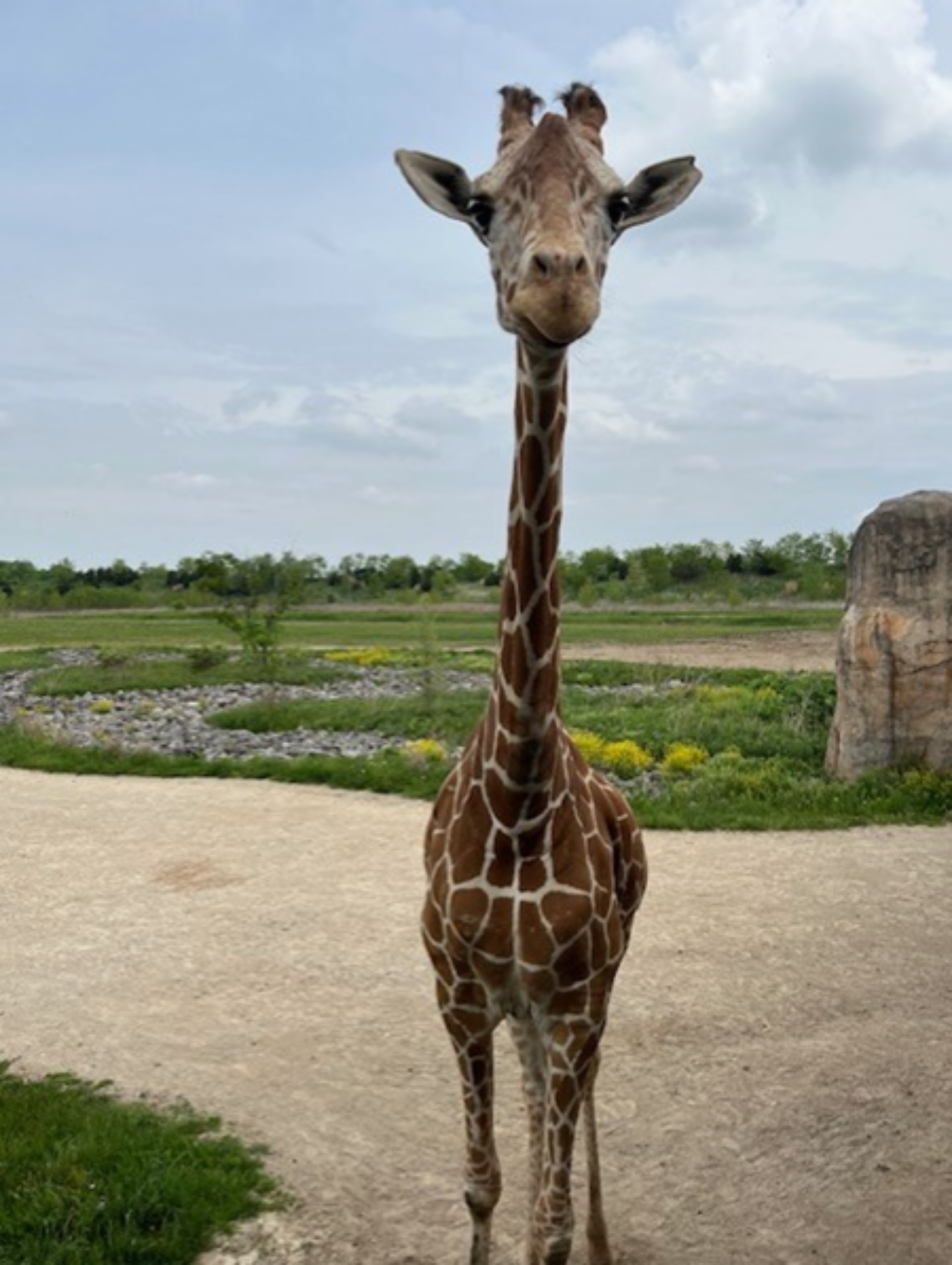
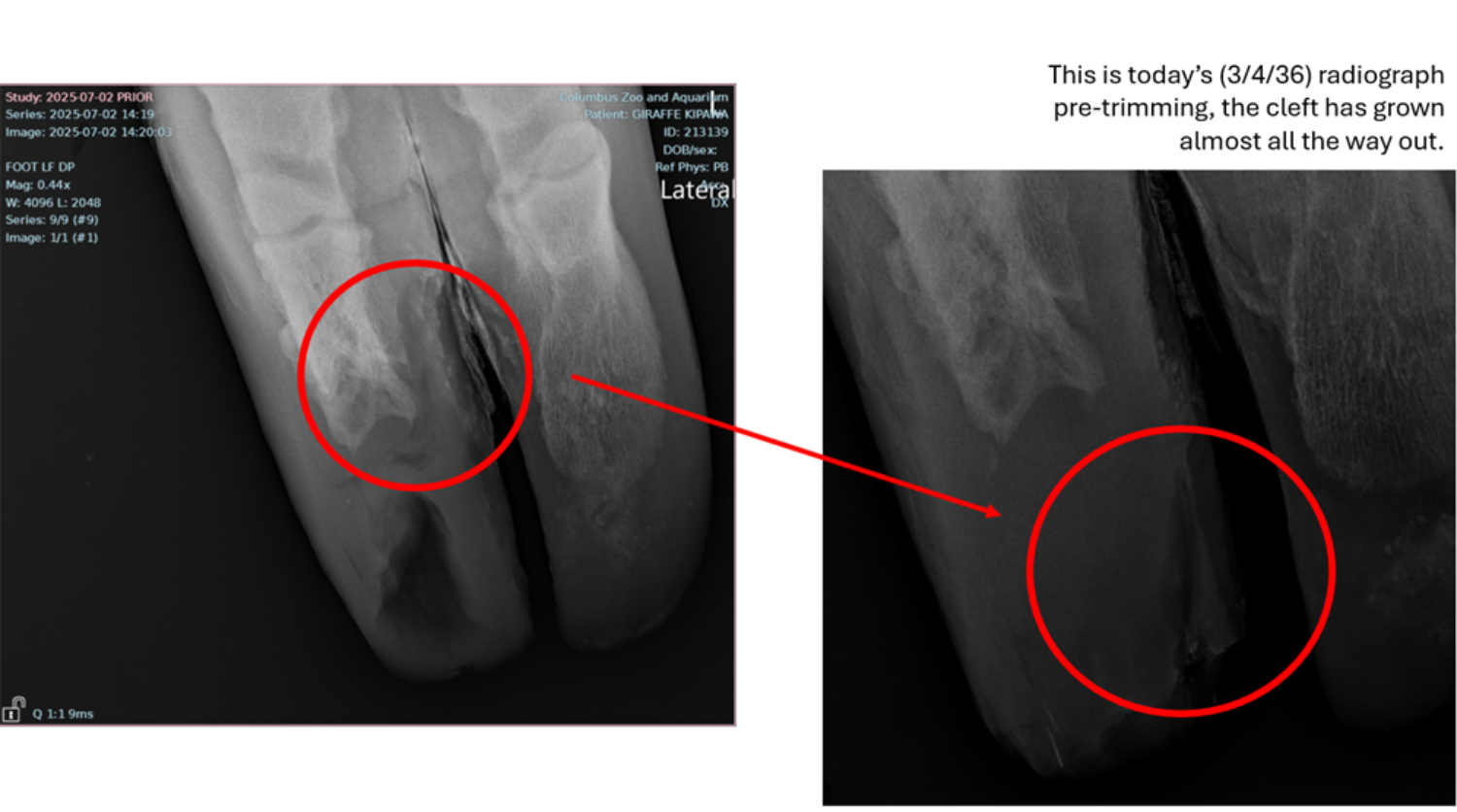
One giraffe who needs some extra hoof attention is Kipawa, a 13-year-old male reticulated giraffe. He was born at Cheyenne Mountain Zoo in Colorado and came to us when Heart of Africa opened in 2014. As a young giraffe, Kipawa sustained an injury to his front left hoof that left the tip of one of his “toe” bones broken off. As a result, that hoof now grows abnormally.
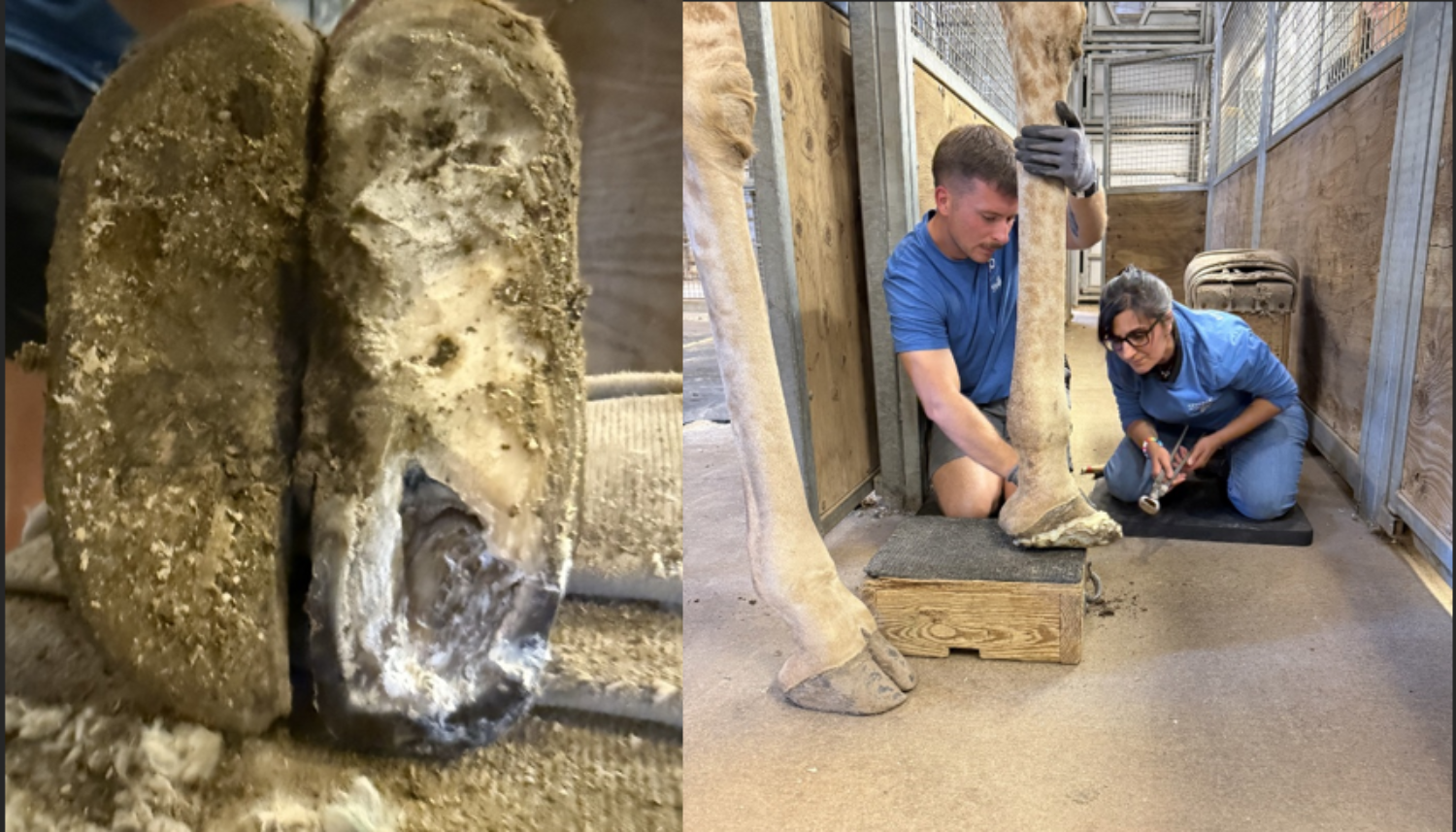
Our knowledge of giraffe hoof care has grown exponentially in recent years, so when Kipawa first came to Columbus, we knew less about how to best manage his injury long term. Over time, air pockets developed as abnormal hoof tissue grew around the damaged area. After we gained a better understanding of giraffe-specific hoof care and consulted with Steve Foxworth, we developed a plan to address the issue by fully removing these problems areas and establishing a new baseline. With the assistance of Steve and Dr. Priya, we removed a large amount of tissue, which required Kipawa to wear what we called a “slipper” to keep debris out while healthy tissue grew in. Also, he had to be restricted to dry areas to ensure moisture wasn’t getting caught in the slipper. Led by keepers Megan Fulk and Zach Jenne, Kipawa’s slipper was replaced every few weeks to ensure it stayed clean and to monitor growth. All of this occurred with full voluntary participation from Kipawa.
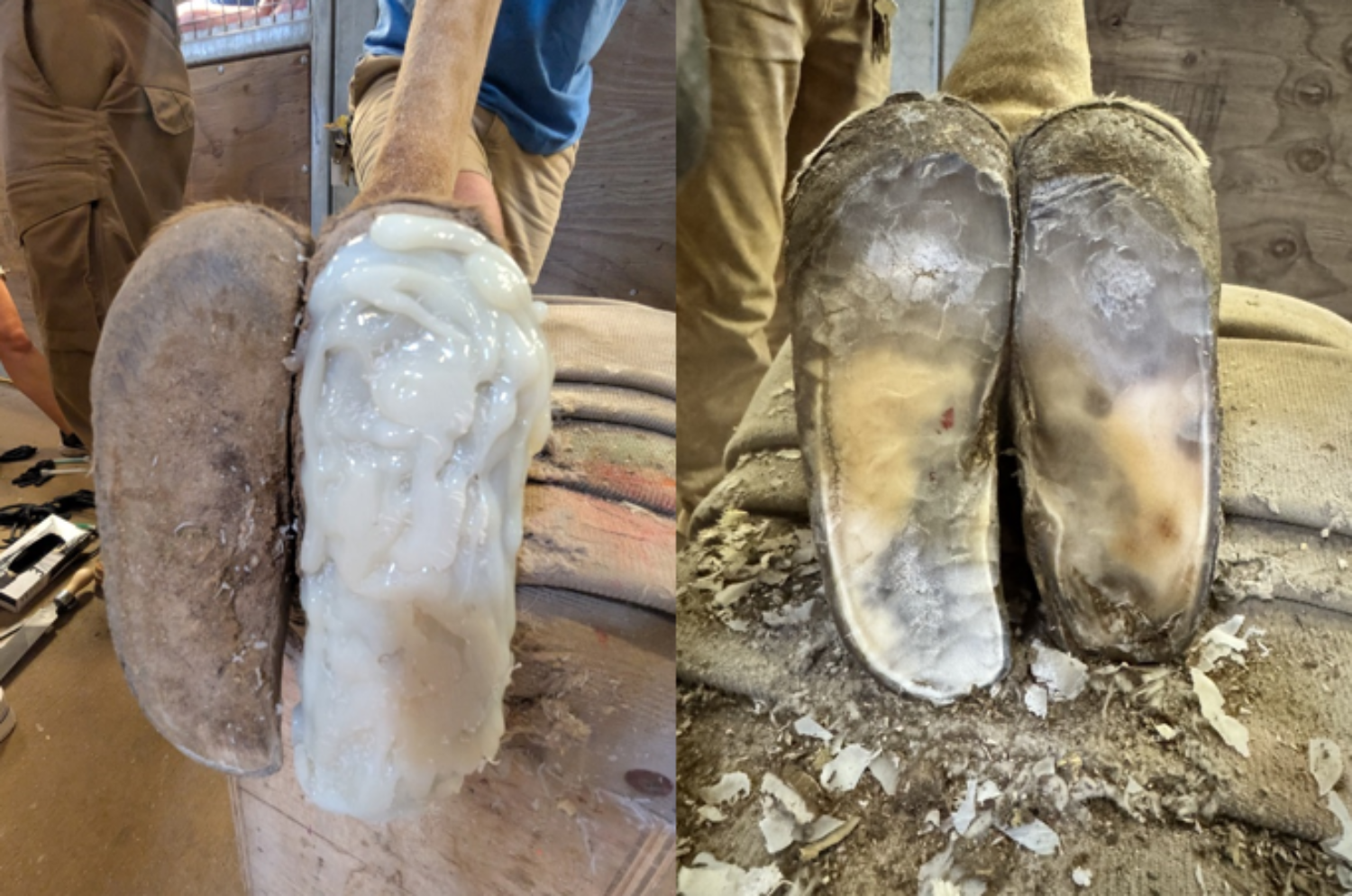
This whole process began in July of 2025, and the slipper was removed for good in March 2026. Thanks to the hard work and collaboration of Kipawa’s team, he now has a healthier hoof for the long run. We are still monitoring a small area that is continuing to grow out, but now he only needs a thin layer of super glue, and he is free to roam the savanna!
Bonus Content! Check out this video of Kipawa’s slipper being applied! Watch Video
March 2026 - "Set Up for Success: A Wellbeing Story of the Weedy Sea Dragons"
By Aaron Jeskie, Shores
The wellbeing of all animals that live at The Columbus Zoo is one of the highest priorities for our park. When many people think of animal wellbeing, they picture enrichment devices for gorillas, hoof care training for giraffes, or carcass feeding for our wolves. But what many might not think of are the ways that the Shores region provides for some of the zoo’s smallest inhabitants - including roaches, corals, and even fish fry. When Shores keepers found out that the zoo had the opportunity to care for weedy sea dragons, they knew they had a responsibility to make their wellbeing the highest priority right from the beginning. This is their story.
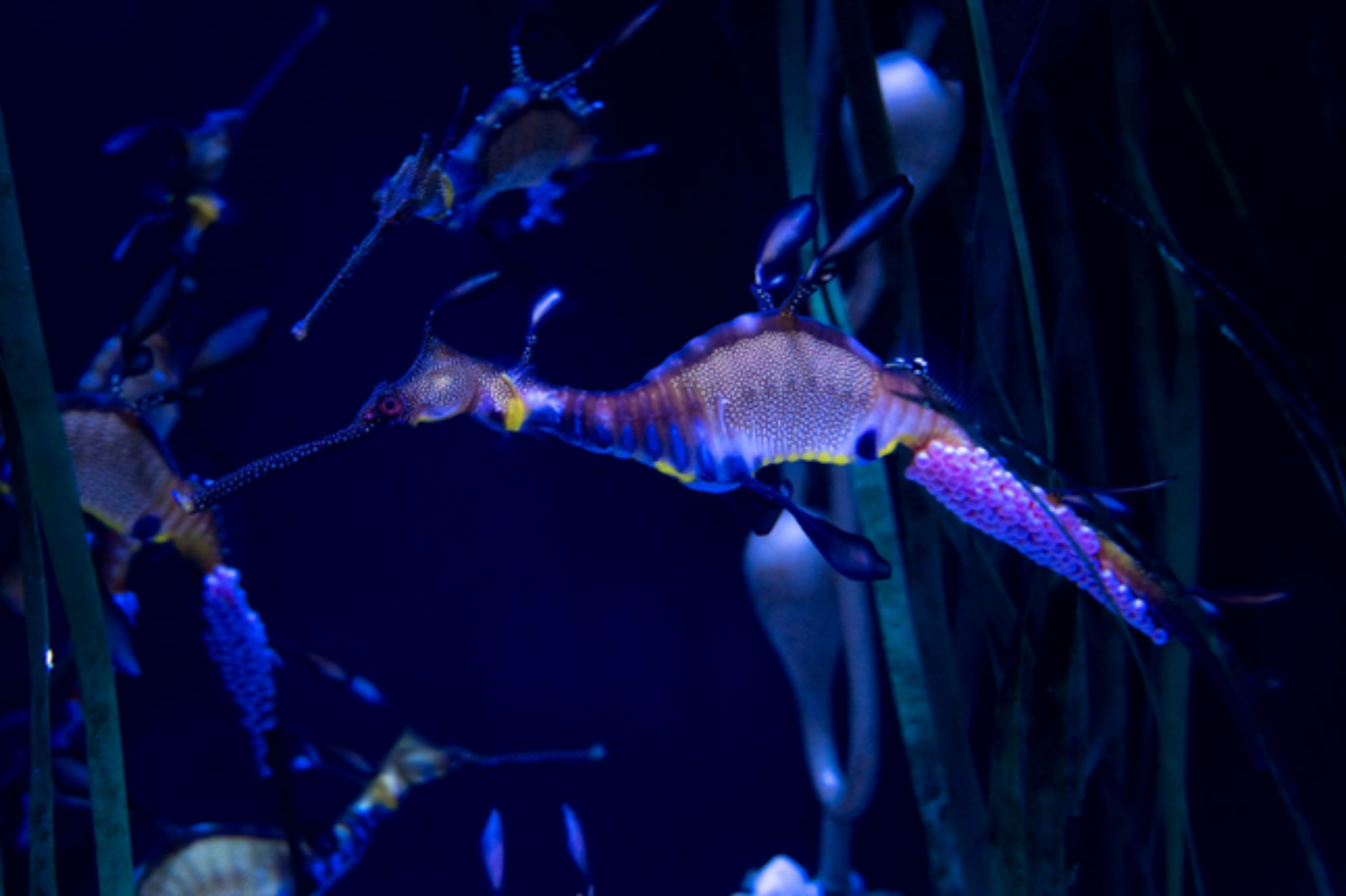
Many months before the first weedy sea dragon would arrive, the Shores and LSS teams started brainstorming on how to create the ideal aquatic habitat for the new dragons. This was no easy task as weedy sea dragons can be very delicate and have very specific requirements for optimal health. One of their husbandry goals was to eventually have a breeding population, something that only a handful of other institutions had achieved at the time. This would require a habitat that had the right amount of water flow, the correct aqua-scaping, and most importantly, the correct habitat dimensions. Lighting and temperature were other factors that had to be carefully planned, as both parameters change monthly to mimic a sea dragon’s natural environment. Life support equipment also had to be carefully selected to reduce the noise and vibration levels for these sensitive creatures. And finally, a food source had to be thought through; weedy dragons are notoriously picky eaters and typically only dine on live mysis shrimp.
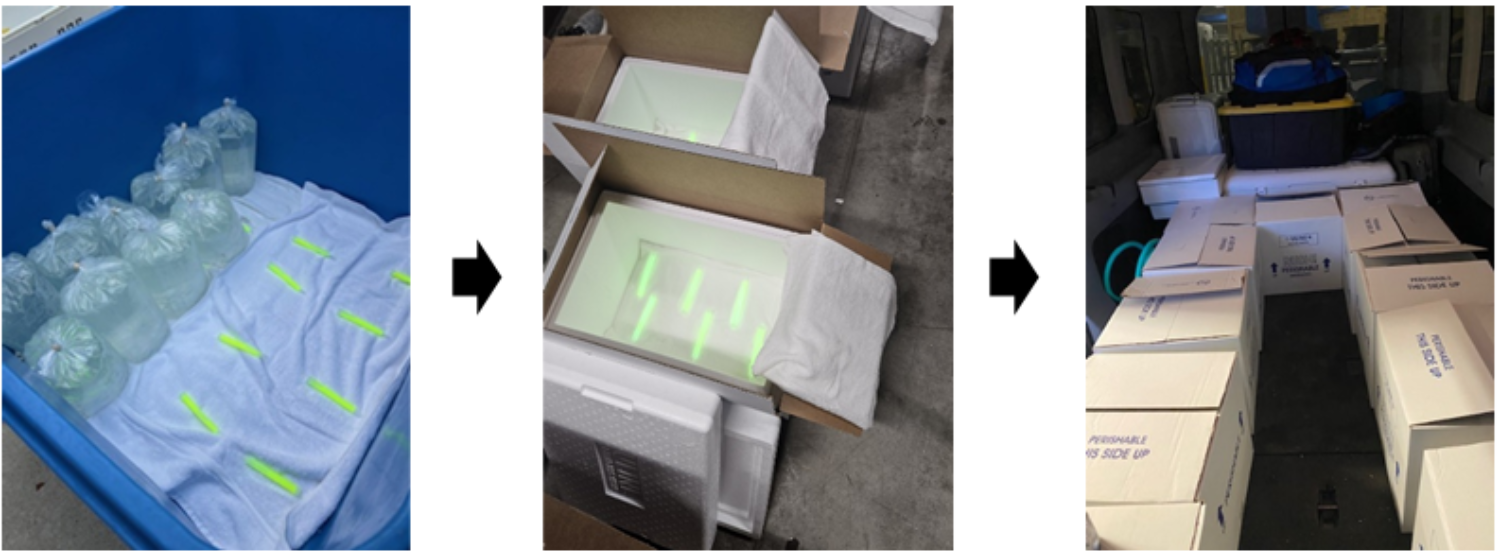
Once the wellbeing goals of building a new habitat were realized and the Shores team felt we were setting up animals for success, it was now time to acquire the Zoo’s first dragons. The team’s care and dedication to animal wellbeing continued with the first planned shipment of sea dragons coming from the Geogia Aquarium. Fish transport is inherently risky and has many variables that can often go wrong, so careful planning was a must. The transport was scheduled during the dragon’s coldest season so that if the temperature of the water should rise while enroute, it would still be within the dragons’ natural ranges (55°F-66°F). These conditions were not so optimal for the keepers in the transport van, however, as they had to dress in layers and had the AC blowing full blast for the entire trip. Keeping the animals comfortable in their shipping bags was another challenge. The water in the bags had to be saturated with oxygen before packing and the bags had to be free of any excess air to prevent the dragons from ingesting bubbles and becoming buoyant. To help prevent this, a glow stick was placed at the bottom of each bag to help orient the dragon’s attention away from the surface. If a sea dragon does become buoyant, the condition becomes a health concern as they will typically stop eating until proper buoyancy can be reestablished. In the end, they were able to make the 10-hour trip with very little rise in water temperature and all dragons arrived happy and healthy!
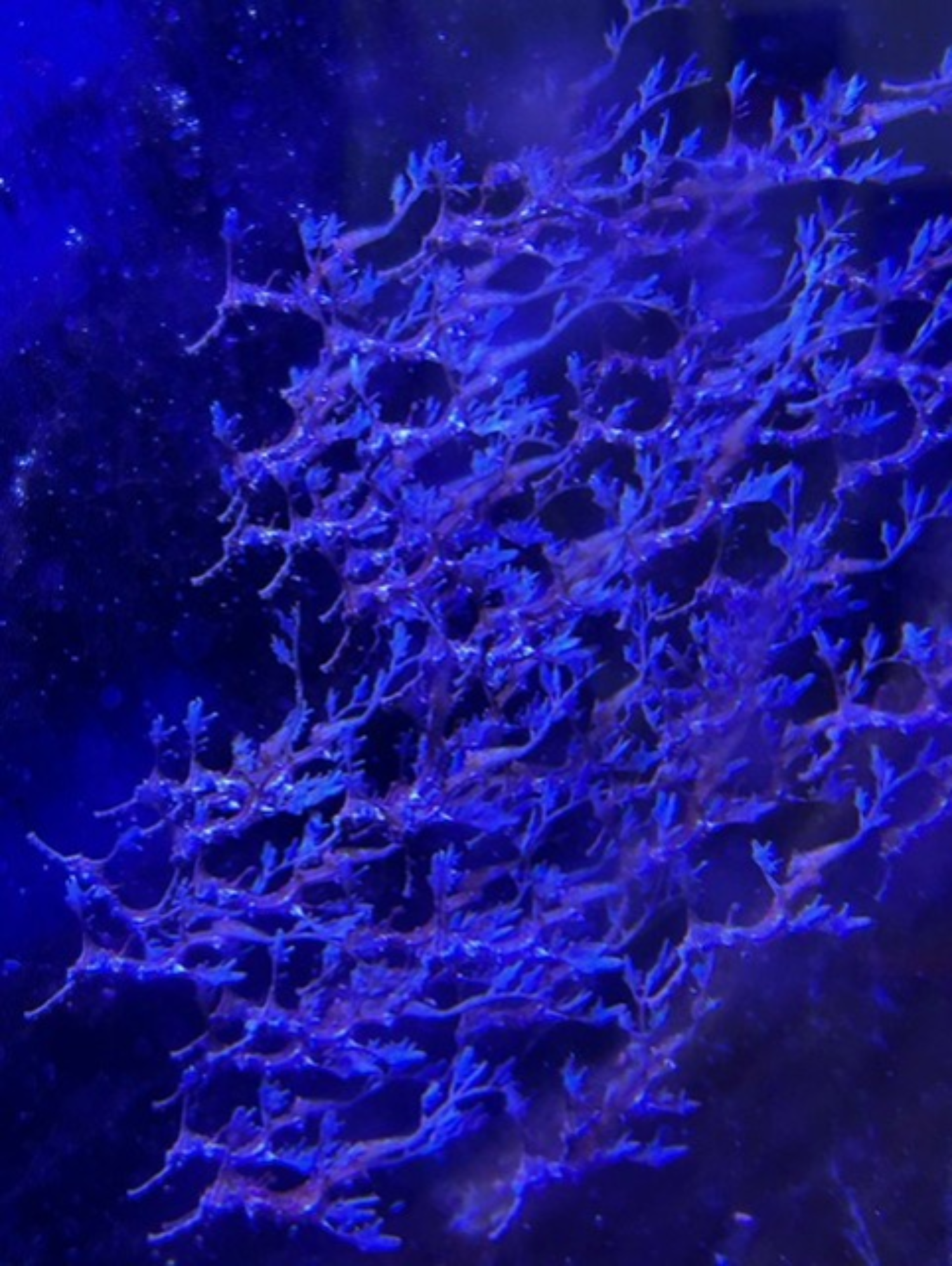
Over the next year and a half, once it was determined that our dragon population was thriving, more individuals were able to be acquired directly from Australia to help increase the Zoo’s “herd”. How did we know our animal’s wellbeing was being met? On Easter morning 2024 during routine morning checks, it was discovered that one of the male dragons was holding eggs. This was a monumental first for the Zoo and a high stress time for the Shores keepers. The weedy dragons were not feeling the same stress though, because feeling comfortable enough to perform the elaborate mating and egg transfer “dance” meant that we were meeting or exceeding these animals’ wellbeing needs. This is where habitat design came into play because in order for a pair of weedy dragons to have a successful egg transfer from female to male, they need enough vertical and horizontal swimming space. The pair of dragons will slowly rise toward the surface but if they run out of room before an egg transfer happens, the eggs will either fall to the ground or the pair will terminate their courtship. While dragons typically spend most of their time foraging near the bottom of the habitat, the “unused” negative space in the upper portion of the habitat is an ideal place for breeding and egg transfers.
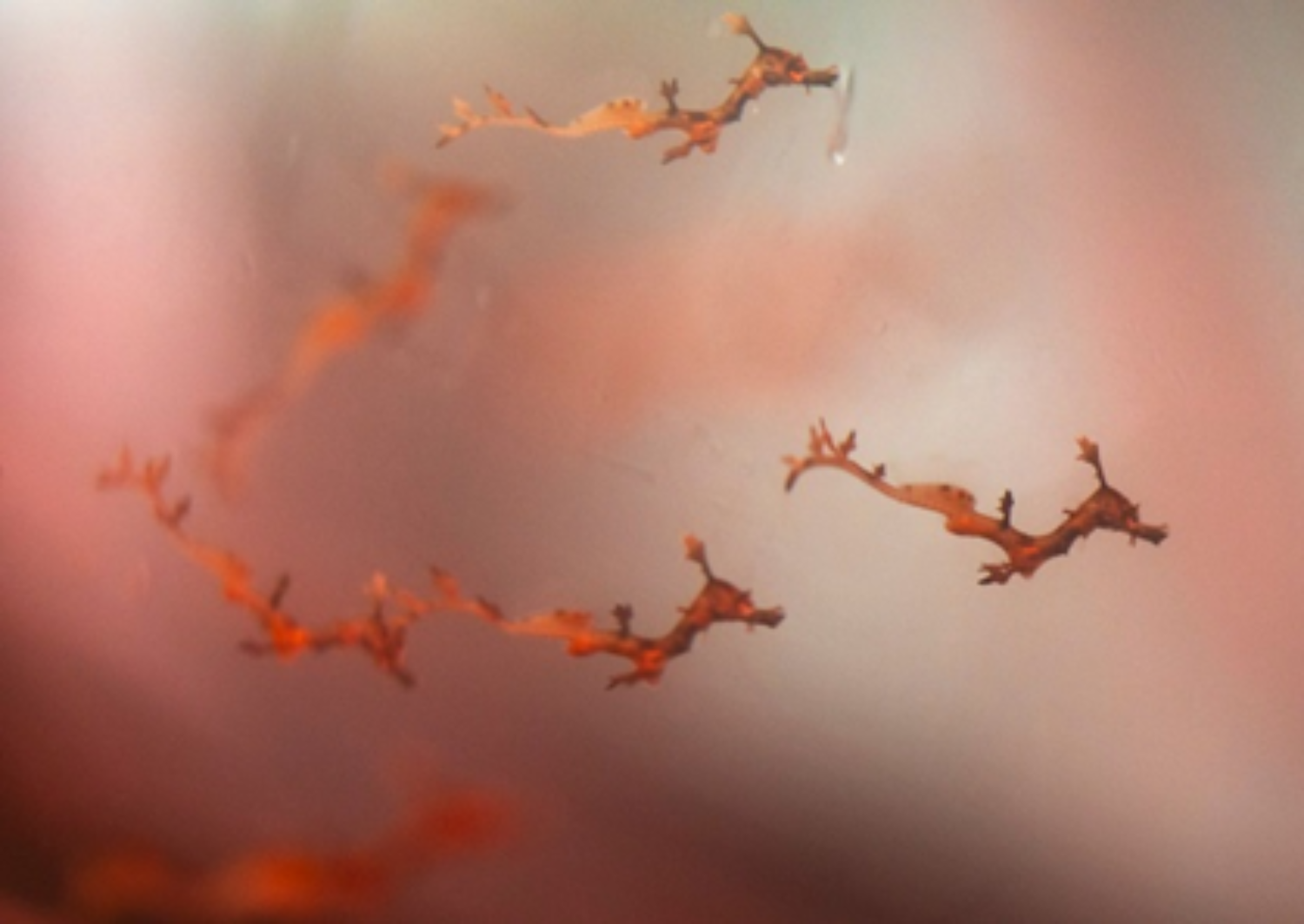
The following breeding season proved to be just as exciting as the first, which was again a testament to the exceptional husbandry by the Shores keepers and the overall wellbeing of our dragon population. The 2025 breeding season set a world’s first with five male weedy sea dragons holding eggs simultaneously with a total of seven egg transfers in one season. Over 300 baby sea dragons were hatched last year and it quickly became apparent that we would not have the resources (time, food, and money) to feed 300 new mouths long term. Luckily, several major aquariums stepped in to agree to house many of these new babies. Now, our biggest husbandry challenge was to ship 100+ very young weedy dragon babies across the country. Weedy dragons tend not to be shipped before six months of age due to their delicate nature, but Shores could not wait that long. Once again, this led Shores to prioritize animal wellbeing by drawing up brand new best practices for transporting young sea dragons. By pre-sterilizing the shipping water, adding stress reducing products, and carefully planning shipment details, the Columbus Zoo became the first known institution to successfully ship sea dragons as young as 3 weeks old. These shipping practices have now been used by other aquariums looking to ship young dragons.
The story of sea dragons here at Columbus Zoo has been filled with triumphs and challenges but throughout the journey we have never lost sight of the importance of animal wellbeing. Throughout designing a new habitat, planning husbandry practices, and making groundbreaking achievements, everything started with setting up our animals for success.
Check out a brief video of two weedy sea dragons courting and getting ready for an egg transfer below!
February 2026 - "Alligator Brumation and Training at the Zoo"
By Mallory Seibold, Shores
What is brumation and why do we practice it here at the zoo?
Most reptiles found in temperate climates will go through brumation cycles at some point during their life. Reptilian brumation, like mammalian hibernation, is a physiological response to cold weather events in which the animals go into a form of torpor. Their metabolic rate slows down significantly and they become lethargic. However, reptiles, including alligators, do not completely zonk out as they have periods of activity on warmer, sunny days. Alligators will often brumate in muddy “gator” holes alongside aquatic habitats and during those sunny days will emerge from their hides and use their thick scutes (the boney plates that run along their backs) as little heat conductors. These scutes contain a lot of blood vessels and as the sun warms up, the vessels send warmed blood through the rest of the body. During these short warm periods, an alligator may drink water but will not eat (intermittent cold temperature drops are not good for ectotherms who have food sitting in their digestive system). Brumation cycles can last up to 5 months for some reptiles depending on their range!
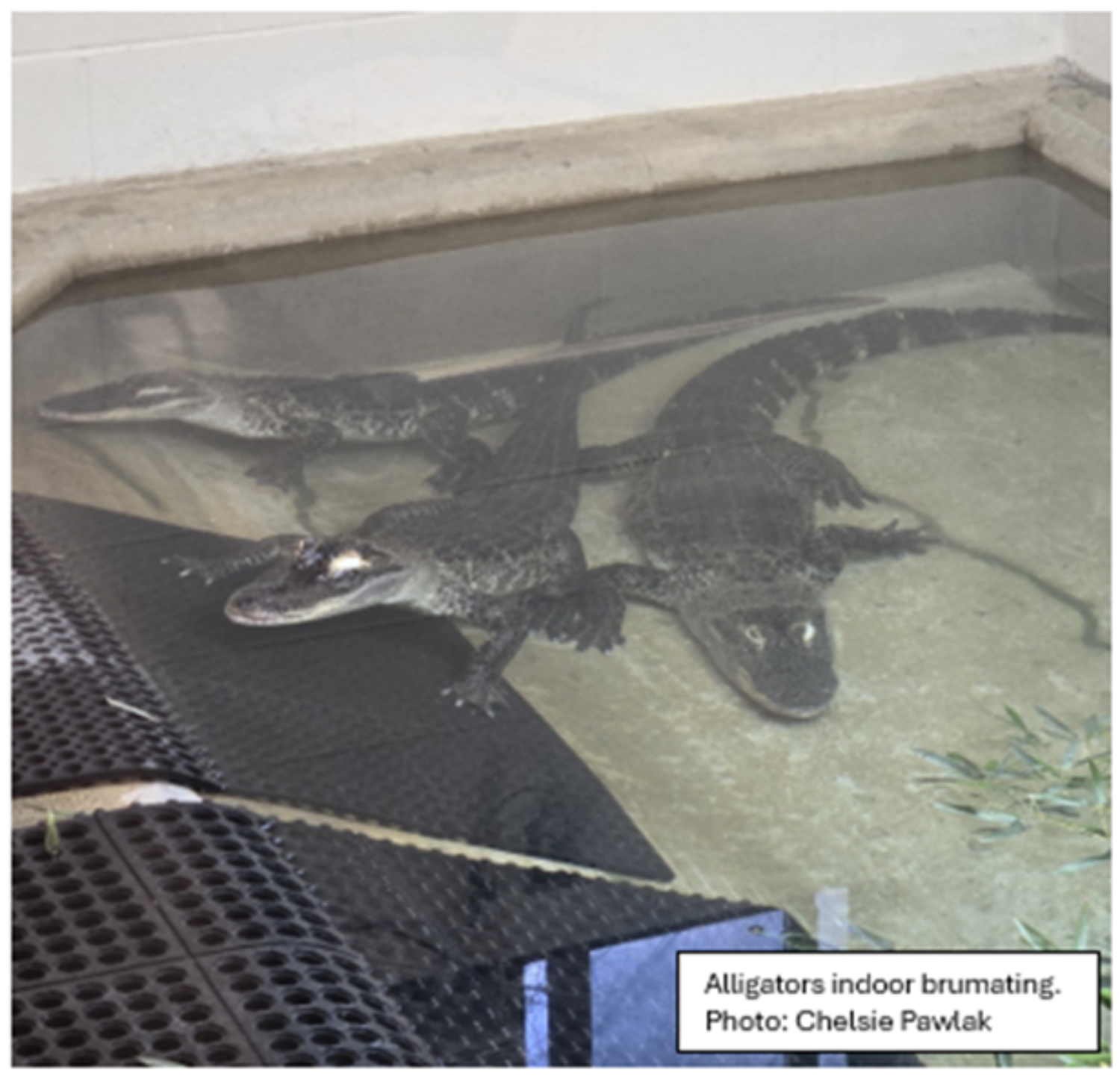
Although brumation is a natural process in many reptile species around the world, it is not always done in a zoo setting. It is practiced on a more individual basis, with many factors being considered. For example, we brumate our 3 alligators due to indoor space limitations and outside temperature parameters.
This brings us to training: why train an alligator?
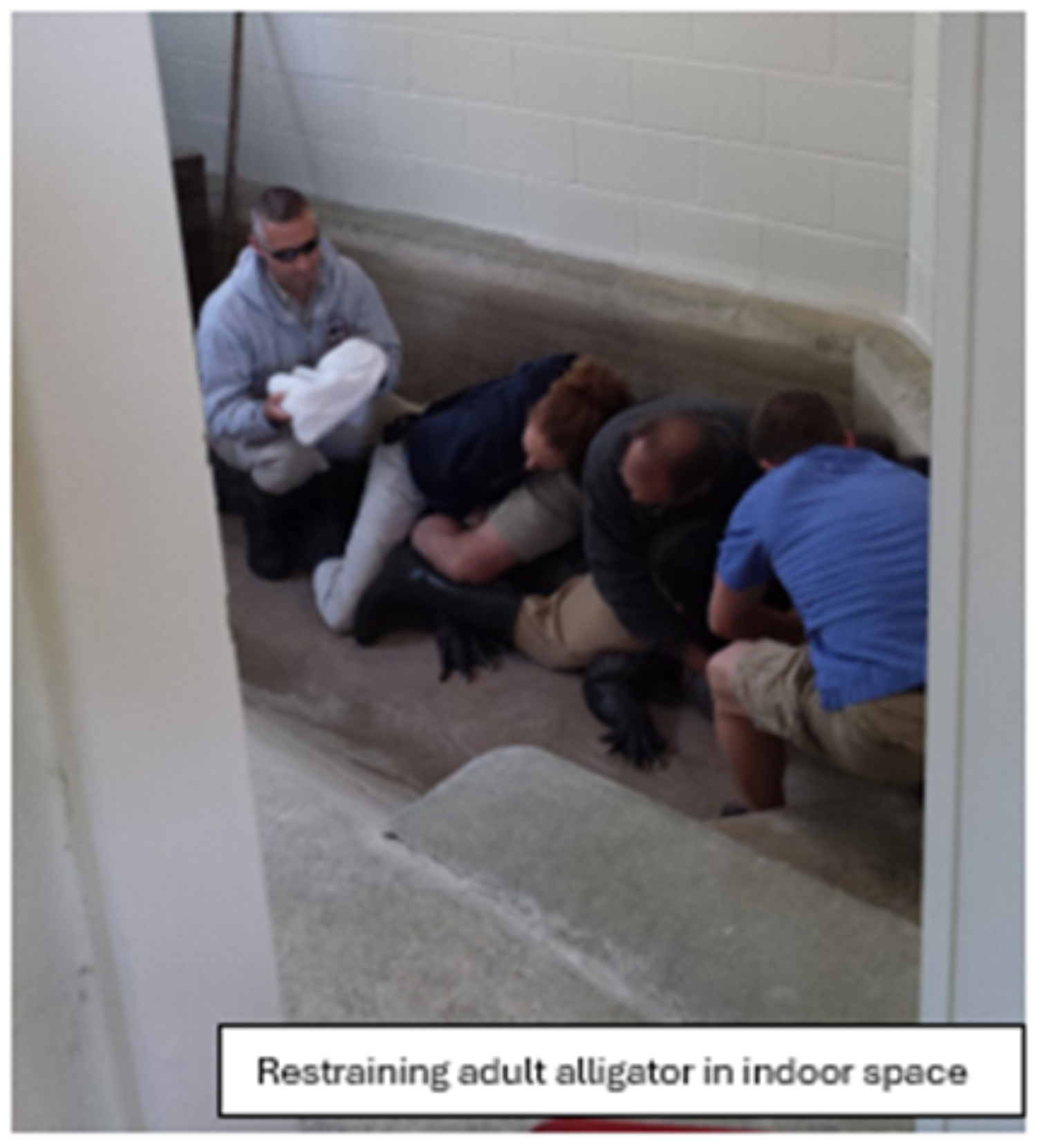
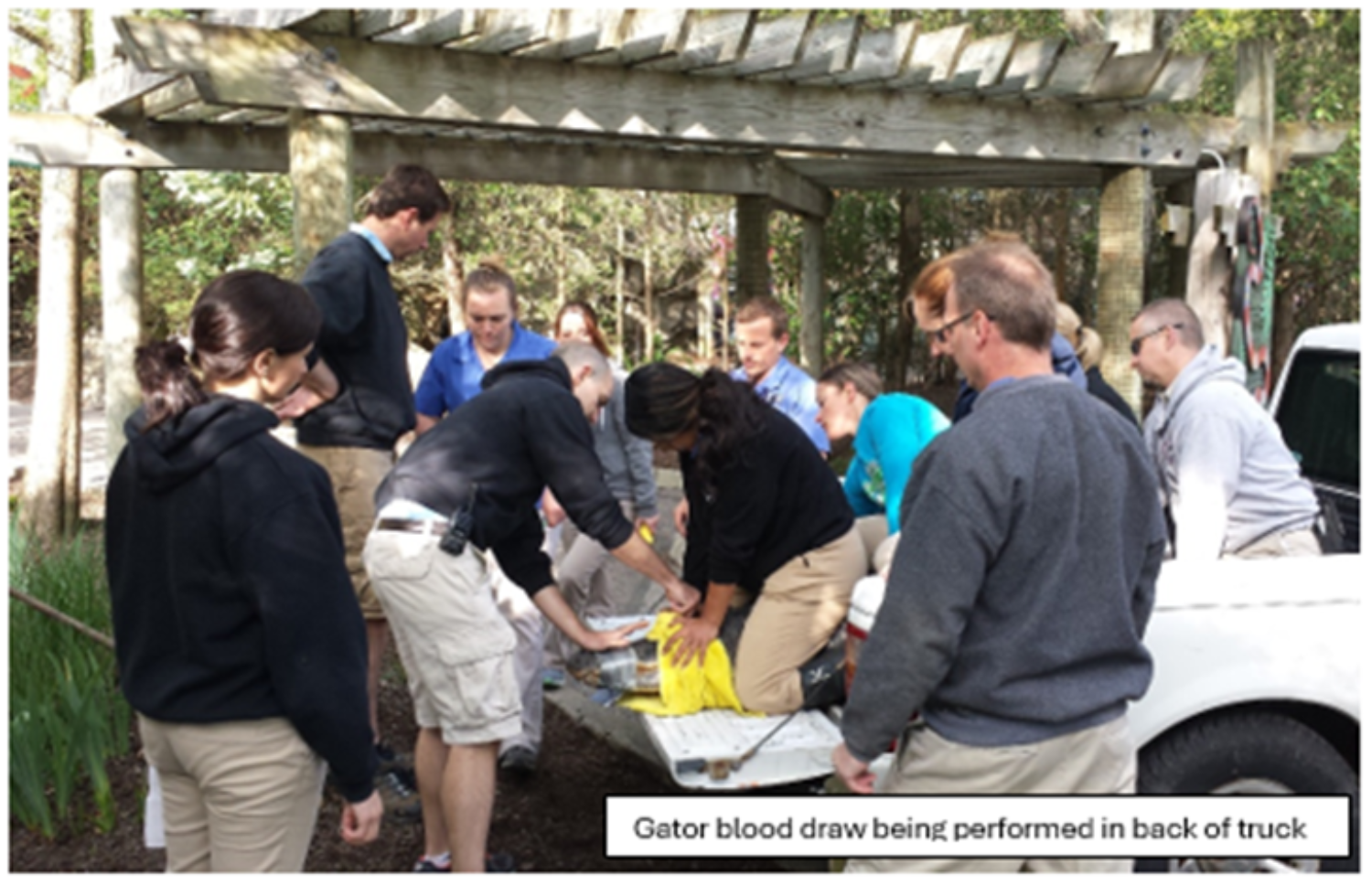
Historically, moving an alligator to the outdoor exhibit or to the hospital for a medical exam involved physically jumping on the alligator to manually retrain them, taping their mouth closed for safety, and carrying them from Point A to Point B. This was an “all hands-on deck” approach that typically required all Shores staff available that day (a minimum of 5-6 people). In fact, every keeper trained to work with large crocodilian species had a final check off which included jumping an alligator for a physical exam and move. The “jumper” would start and be the one in control of the head. Then others would follow until at least 3-5 (depending on the alligator size) straddled the gator using their weight to restrain the animal while being careful of its extremities. Once the head was controlled, another keeper would put electrical tape around its mouth, and everyone would then lift the alligator and move it to the vehicle where we would transport it to the desired location. Our veterinarians would typically perform an exam, (including bloodwork if needed), and we would weigh each alligator.
Though we have somewhat moved away from this with our voluntary training, manual restraint of alligators is still an important skill for keepers to have in case of emergencies. Therefore, all keepers working alligators (or any crocodilian species) are trained in this technique. That being said, it is more invasive and does not give the alligators choice and control over their environment. This is why training is so important, not only for the building of trust and relationships but also giving animals agency to voluntarily participate in procedures for their own wellbeing.
Our Alligators – Sedgwick, Cattail, and Lily Pad
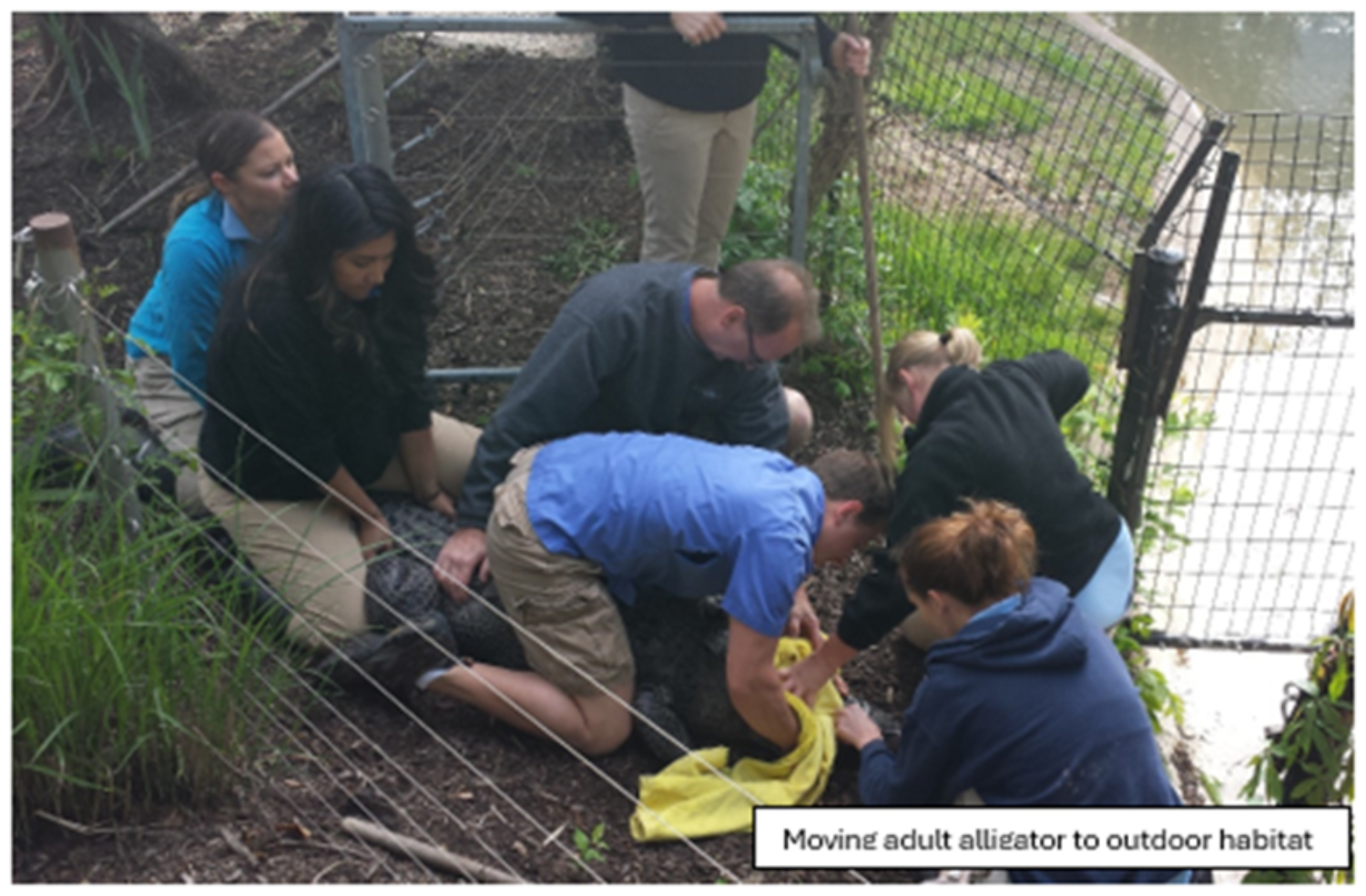
We received our 3 juvenile alligators from Wild Encounters in March of 2020. They were too small for our exhibit (plus we still had our adult female, Girl, who was destined for another institution), so they lived in our indoor holding room for 3 years. This room is temperature controlled and initially designed as our brumation room. Training started simply with a small target and a gator pellet or pinky as a reward: touch the target, get reward. Slowly the training advanced and so too did the targets. Each alligator had its own color and shape of target on a bamboo stick. They would have to find their own target to get a food reward. We would move around to make sure we were not always in the same location feeding, so they did not associate an area with a reward. By May of 2023, our alligators were each over 10 kg and large enough to move to the outside exhibit space. We still decided the hands-on approach was best for this move, so the Terrestrial Shores team worked together to transport the 3 alligators outside.
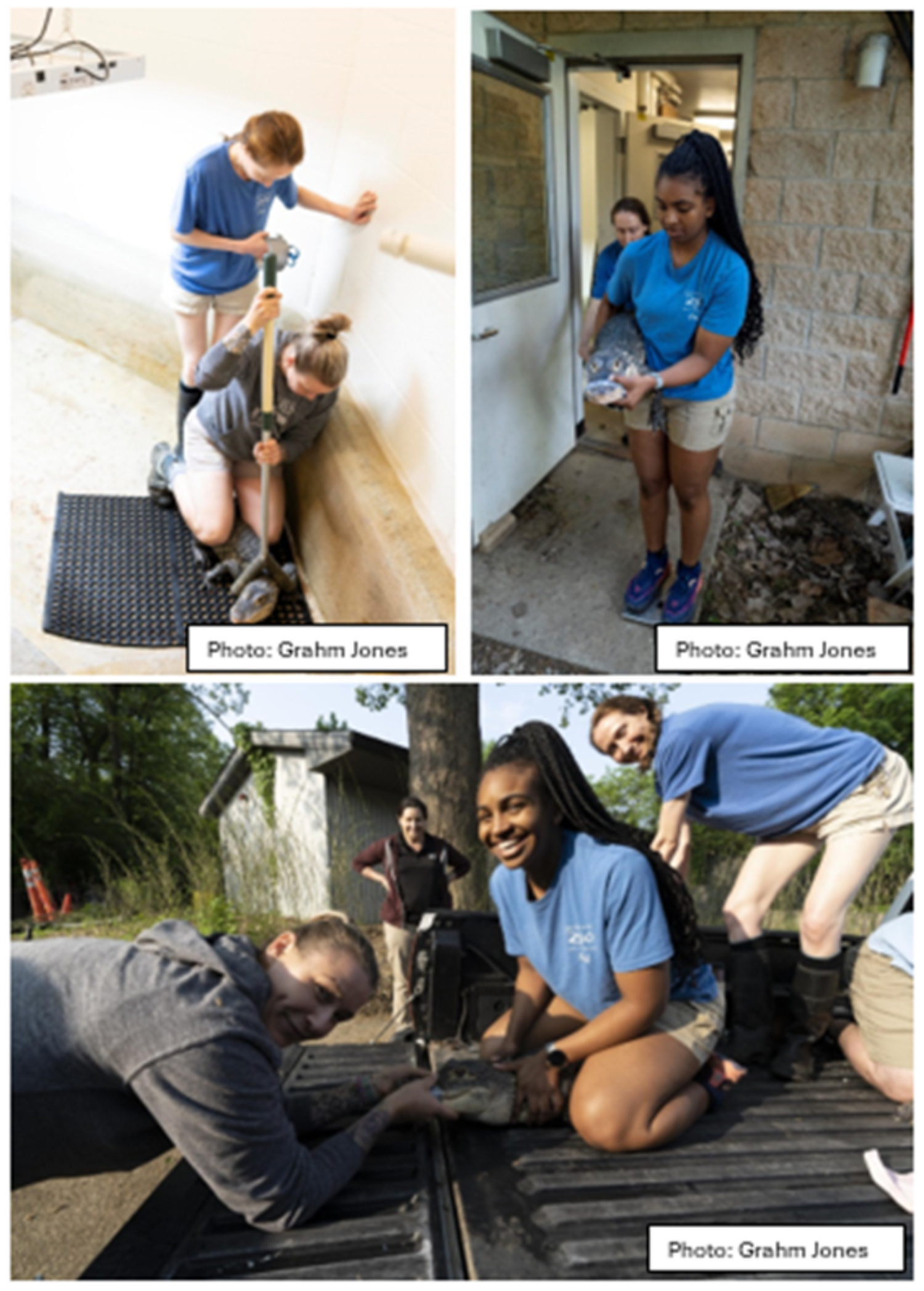
This was their first time in a large naturalistic pool, and they submerged and “disappeared” under the water almost immediately. They were very difficult to spot and required multiple daily checks to make sure all 3 were adjusting well. Luckily, alligators are smart and incredibly food motivated so we were able to get them to target train again quickly, but this time we added a wooden platform to the training process.
They began to get comfortable enough to follow their targets out of the water and onto land near our makeshift platform. Each alligator moved at its own speed, with Cattail being an exceptional trainee and Sedgwick being a little more cautious. Lily Pad was a bit in between: some days she trained like she’d been doing it her whole life whereas on other days she wouldn’t come out of the water. Consistency was key with all three alligators.
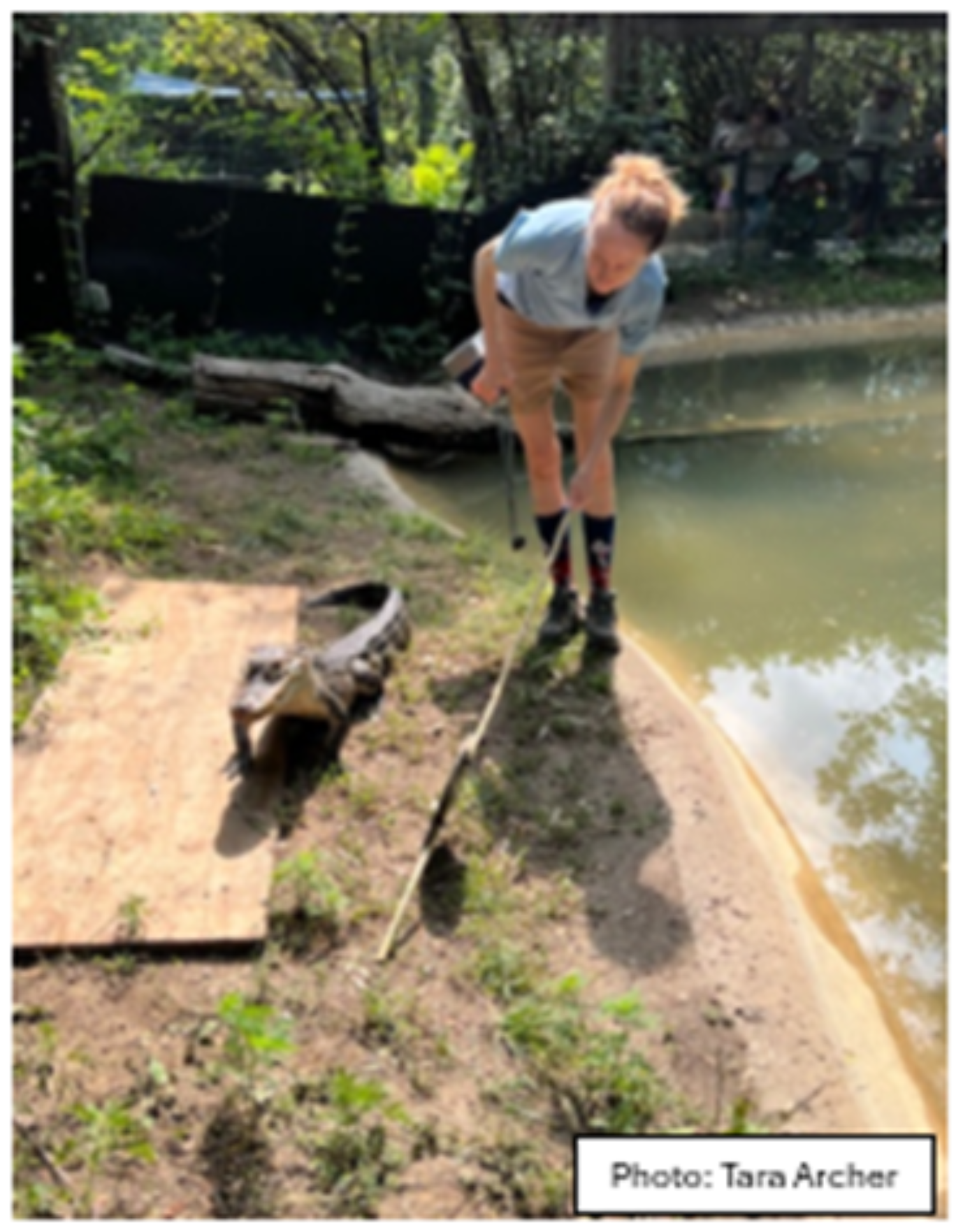
Cattail was our little star! She quickly progressed from the platform level with the ground to the platform raised onto a scale. We began getting regular weights on her, then on Lily Pad. During this time, however, Sedgwick was very hesitant to come out of the water for scale training, so we focused more on trust building and open mouth commands. We added novel foods into their training sessions including chicken and large trout as rewards for improving shaping of behaviors. Sedgwick began to voluntarily come out of the water for chicken! We finally had all the alligators ready to advance to their transport crate that was made by our maintenance staff. Unfortunately, the summer was almost over so the crate would have to wait until they moved inside for the winter. Due to their small size, we kept Cattail, Lily Pad, and Sedgwick warm throughout the entire winter so training could continue.
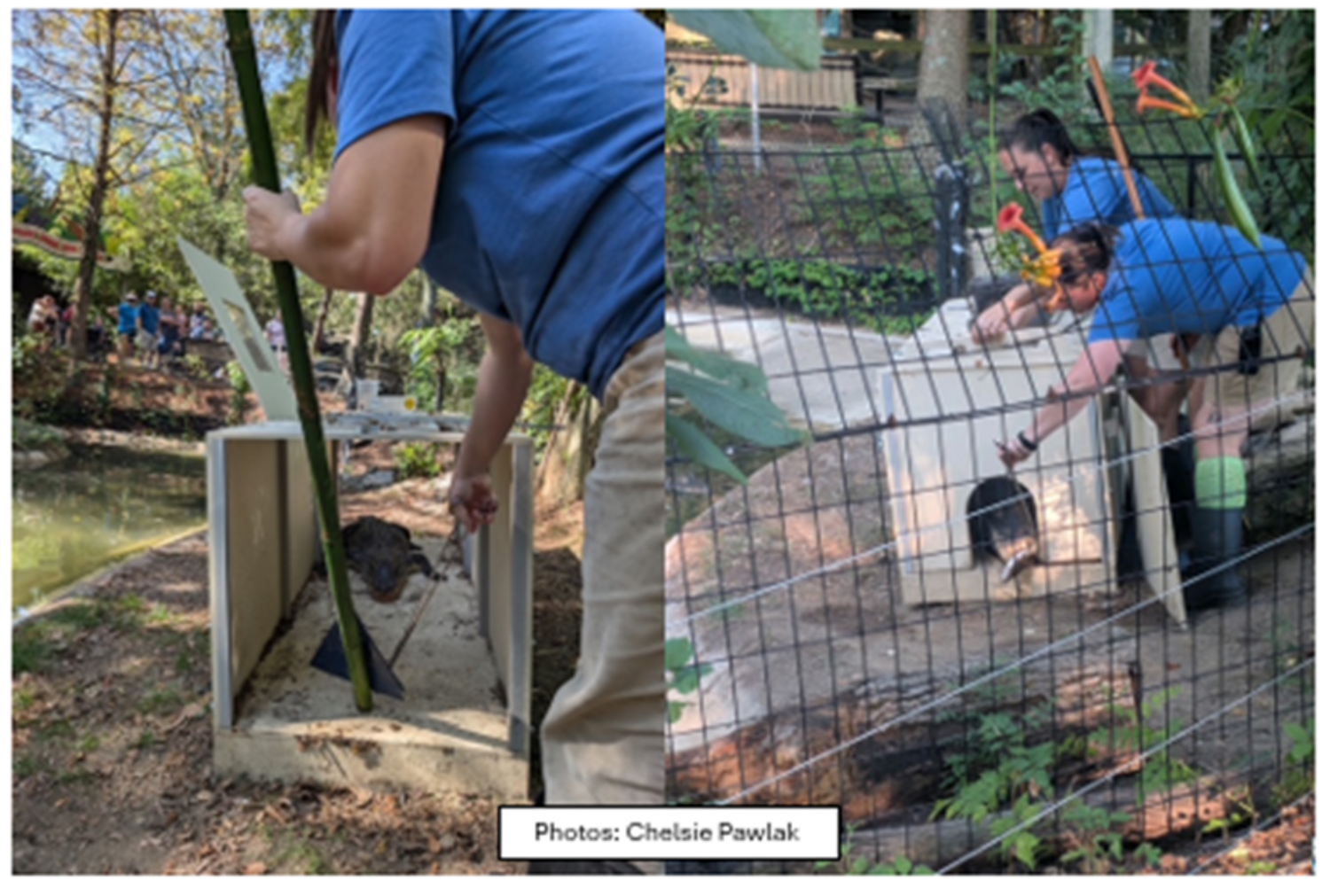
Because we trained throughout the winter, we were able to get each alligator to voluntarily enter the crate and be locked in for a short period. We then used this behavior to transport the animals from their indoor space to their outdoor exhibit when the weather warmed up to appropriate parameters once again.
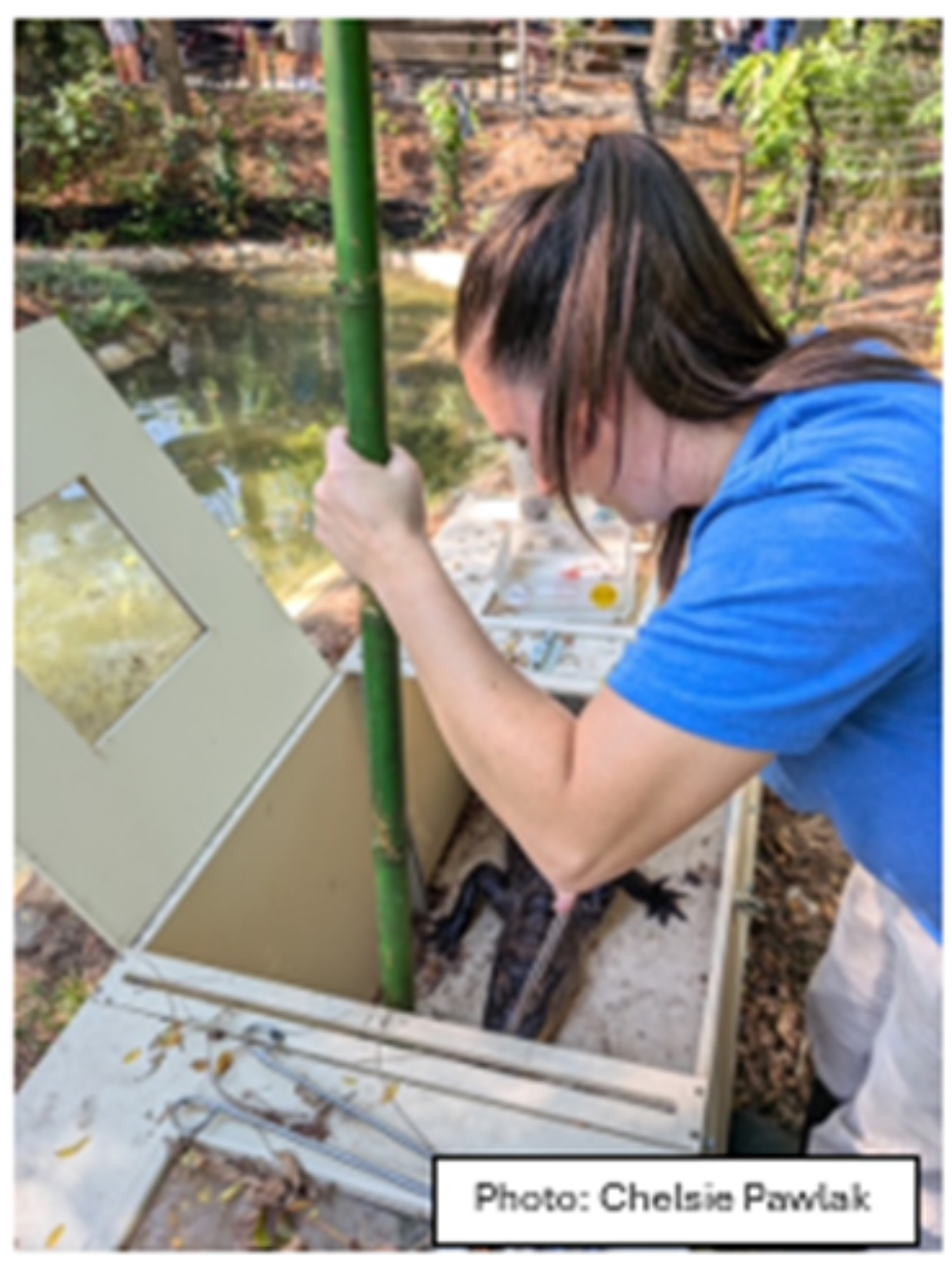
We did run into a few hiccups now and again with crate training, specifically with Sedgwick and his hesitancy to train after changes to his surroundings (e.g., moving from inside to outside) but our 3 alligators have all been incredible in remembering and progressing in their training sessions each year even after brumation that can last 3-4 months (we began brumating our alligators in 2024 once they were all over 6 feet long)!
The summer of 2025 was our first year of the alligators willingly and consistently crating themselves for transport both to and from their holding rooms. We will continue to include our scale and crate in training sessions, but we are adding tactile sessions to desensitize the gators for more manual manipulation during exams. We are very excited about what the future of our alligator training holds for us and for them!
Below is a video of the Shores Alligator Training.
download Video
January 2026 - "Asia Quest Aviary: A New Way of Catching Birds"
By Sarah Kirkman, Asia Quest
In 2025 we attempted two new methods for catching our temperature sensitive birds in the Asia Quest outdoor aviary. After discussing the idea during a previous Wellbeing Oversight Subcommittee meeting, we had a catch cage added to the corner of the aviary early in the year. In May, we opened the cage up for the birds and started providing food bowls inside. Ann Wookey, Asia Quest Zookeeper, also started training with a clicker as an auditory cue for birds to approach and enter the catch cage for bugs.
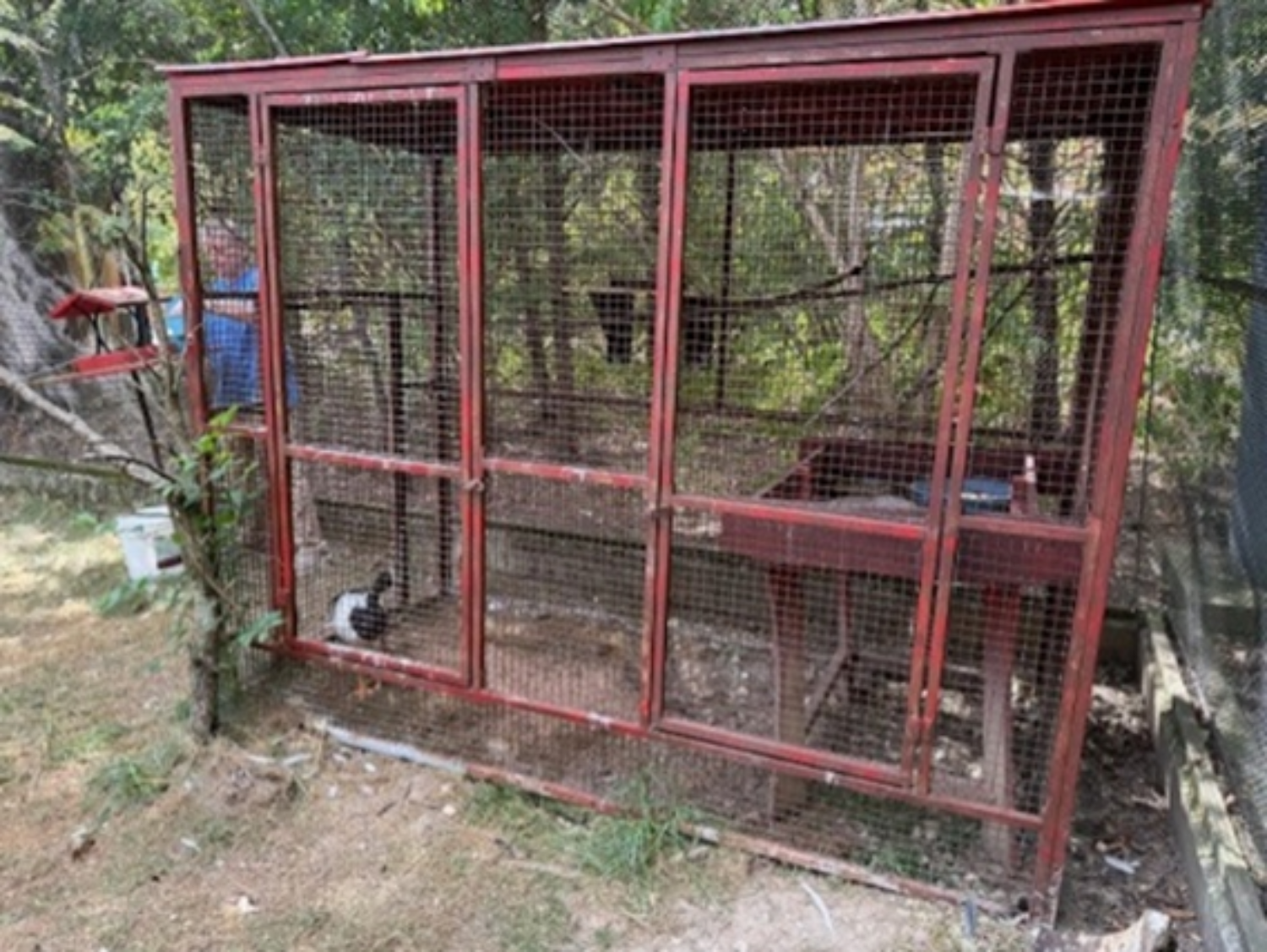
By fall we were having a lot of success with birds entering the catch cage, with the Nicobar pigeons and magpie geese being the rockstars. Their reliability turned out to be a wellbeing win for the pigeons since they are the most cold-sensitive birds in the aviary. All 4 pigeons were voluntarily caught in the catch cage and brought in for a cold night in October. Then, they were released back outside for an additional 2 weeks before being caught again in the catch cage and brought in for the winter.
Historically, Asia Quest rounded up all the birds who move in for the winter at one time. Usually this was mid-October when the most sensitive birds needed to come in. This has been stressful for the birds and time consuming for the staff in the past. The catch cage gave us the ability to target certain birds and move them inside in stages. Three of the six egrets were also caught in the catch cage in November, while the Northern Bald Ibis was able to stay out until the first week of December.
The ibis were comfortable entering the catch cage only if both doors were open. If the side door was closed, they would not enter. So, we had a new idea to modify our entrance vestibule since the aviary was closed for the winter and turned that into a giant catch cage. Although all 3 ibis were entering the vestibule, the door swung in, so when Ann attempted to shut the door, the ibis would fly out.
We faced a few additional challenges and learned a lot about the comfort levels of the birds and have ideas for increasing our successes with 2026. The 2 pond herons would only enter the catch cage if a keeper was not in the aviary. We utilized drone clips with a towel to “shut” the door of the catch cage but would like to purchase more and weatherproof the set up so we can drop 2 towels reliably to close off both “doors” at the same time.
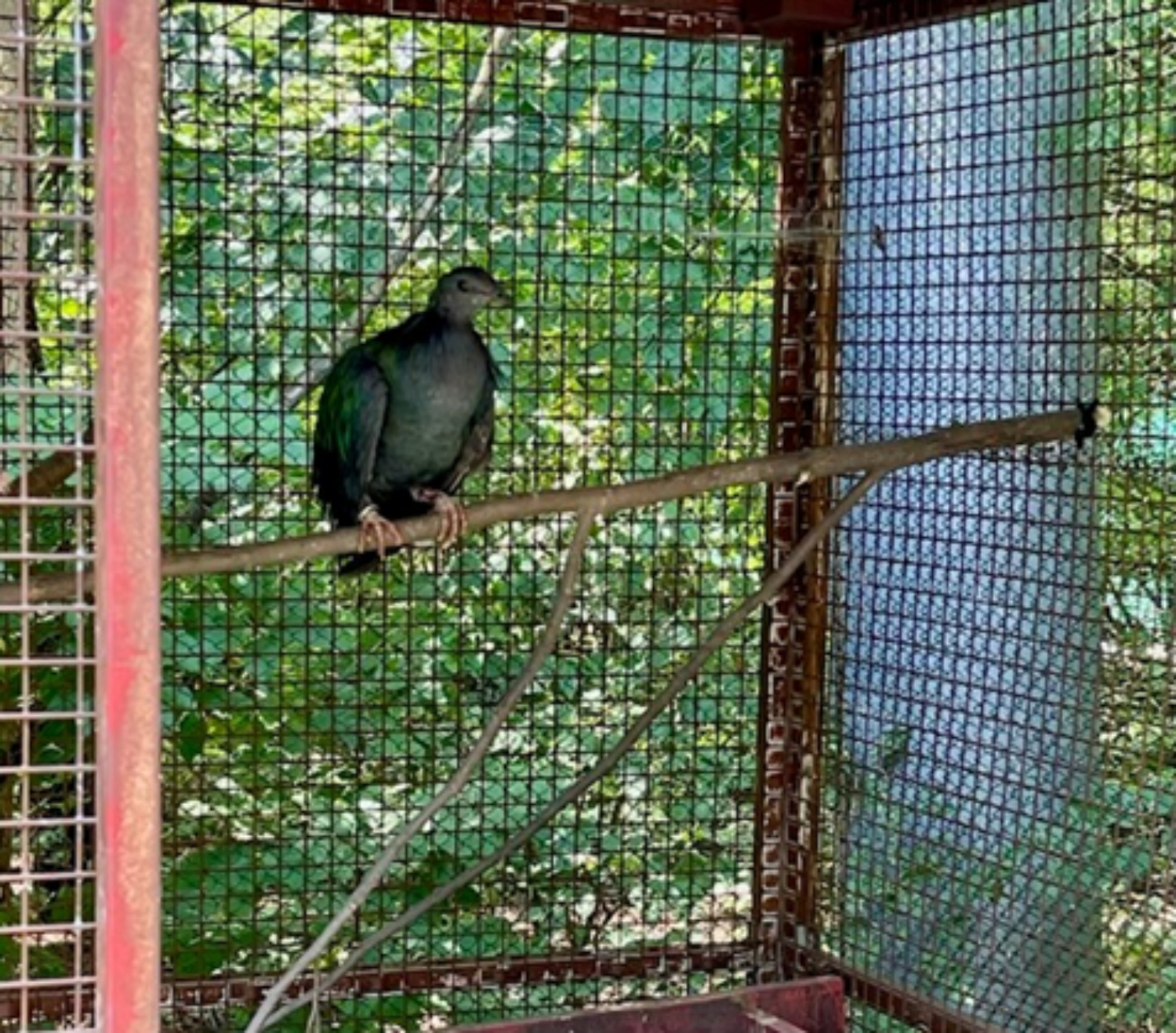
We would also like to switch the hinges of the vestibule door so it swings into the aviary to use this space as a catch cage again. We also plan to open this space to the birds as soon as Boo at the Zoo is over this fall. Another idea was to put cameras in the aviary to pick up on patterns of when certain birds enter the catch cage to eat, especially the pond herons who are the least likely to participate in training sessions.
All things considered, the catch cage was a positive addition to our aviary. All 25 birds who live in the aviary did eat in the catch cage. The pigeons, geese, pheasant and smew duck went in well consistently during training sessions. The egrets and ibis were also going in, but after the first 2 egrets were caught in the catch cage, they were weary of going in for a while. We still had to net 8 birds to move them in for the winter, but we hope with our plans for 2026 we can make the catch cages even more successful!
Previous Animal Wellbeing Committee Newsletters
During 2025, the Animal Wellbeing Committee produced a quarterly newsletter reviewing the animal wellbeing program at the Columbus Zoo and Aquarium. It highlighted various initiatives for animal wellbeing and offered chances for ongoing education by discussing scientific studies on animal welfare. This newsletter is no longer being produced.